
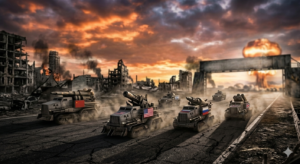
During World War II, Germany fell in the spring of 1945, confirming the inevitability of an Allied victory after six years of the bloodiest conflict in human history. With Italy already defeated, Japan remained the sole Axis power stubbornly attempting to delay the inevitable. Japan was on its knees—bruised and battered—and fully aware of the certain outcome; however, its imperialist government, in its arrogance, was not yet ready to concede, prolonging the war day after day. They could never have imagined, even in their worst nightmares, the cost they would pay for failing to wave the white flag in time. As history recalls, Japan remains the only place in the world where atomic bombs have been used on a living population. The atomic bombs dropped by the USA on Hiroshima and Nagasaki did more than just defeat them; they left the nation paralyzed for years. More than a hundred thousand people died the moment those bombs touched the ground.
History will always debate whether, when the war was already won and surrender was inevitable, the USA truly needed to use such excessive force to accelerate the end of the war by just a few days at the cost of thousands of civilian lives. It seemed to be more than just a desperate attempt to save lives by ending the conflict early; apparently, it was the American way of stamping their authority as the world’s supreme power, ensuring they would dominate the global order once the war was over.
We often say it was the USA that dropped the bombs, but ultimately, it was one man who made the call that wiped out hundreds of thousands of lives in an instant. History provides many “what ifs” to learn from, and perhaps that is why—even after the decades-long Cold War—we have not seen another Hiroshima or Nagasaki, despite reaching boiling points alarmingly close to nuclear war. History faces a big challenge, however: it is often forgotten with time.
After losing eighty million people—nearly 4% of the global population—to World War II, the sane path to peace would have been a collective agreement to renounce weapons of mass destruction. Instead, the world fractured into two opposing ideologies: capitalism and communism. This gave birth to the Cold War between the USA and the Soviet Union, triggering a blind race to amass larger and deadlier arsenals. This dangerous competition was driven by two primary factors: profound mutual distrust and the conviction that superior nuclear capability was the only way to deter the opposition from initiating a strike. For decades, the USA and the Soviet Union remained at each other’s throats, manufacturing thousands of nuclear warheads and developing faster, longer-range ICBMs. They stationed these weapons in locations that left both sides dangerously vulnerable. To further their interests, they toppled regimes, sabotaged democratic processes, and covertly fuelled proxy wars by sponsoring weapons and insurgencies. The volatility of the Cold War is best illustrated by instances where radar systems triggered false alarms of incoming missile attacks. In those moments, people in charge had only minutes to decide whether to retaliate. Fortunately, those responsible didn’t panic enough to fire back, preventing a global catastrophe.
It is a miracle the world survived the Cold War without a major escalation; perhaps the devastation of the atomic bomb was imprinted too deeply on the global consciousness to ignore. Yet history cannot forget that atomic weapons were used twice by the nation arguably considered the most “responsible” and heroic of that era—the one that saved the world from the brutality of the Axis powers. They had a choice, and they chose to use them.
Nearly eighty years after World War II, nine countries now possess nuclear weapons, almost half of which are governed by autocracies. Where once a single leader held this power in 1945, today at least nine individuals have the authority to kill millions at a moment’s notice. As the cruel memories of the Second World War fade, the cries for war grow louder. Ultra-nationalism—reminiscent of the racial supremacy driven by the Nazis—is increasingly resonating with the public as right-wing parties rise to power in numerous nations. During the Nazi era, Hitler used inflammatory speeches to invoke sentiments of national pride, the perceived injustices of the post-WWI era, and the supposed supremacy of the Germans. He promised the rise of a new, great empire. However, these sentiments alone were not enough to command the blind following of millions; he needed a scapegoat. To explain why a “superior” people had endured such misery, Hitler villainized the Jews, blaming them for Germany’s every misfortune. This systematic hatemongering culminated in the Holocaust, where six million Jews were murdered.
Nowadays, right-wing movements across the globe are growing stronger, riding on sentiments of ultra-nationalism and villainizing specific communities to distract from economic and policy failures. The USA—the world’s preeminent superpower that once unilaterally took responsibility for global order—now, in its bid to “Make America Great Again,” appears ready to claim Greenland from its own ally, Denmark. Following a pattern of interventionism, it infiltrated Venezuela and toppled its presidency, leaving a power vacuum in its wake. This was followed by the recent, direct military aggression against Iran. Behind the façade of security and stability to justify these actions lies the subtle truth of “I would because I could.” This mindset bears a haunting resemblance to the one that led to the German invasion of Poland and attacking other European countries because they believed in their military supremacy, sparking World War II. To secure public support, the current USA government’s invocation of national pride is complemented by the villainization of a specific group: immigrants.
It seems that deterrence has become the only viable solution since the world failed to learn from its mistakes and refused to renounce weapons of mass destruction. The fear of total annihilation currently keeps the impulses of nuclear-armed leaders in check. However, while wars like the Second World War often began with full-scale invasions, the higher probability in today’s turbulent times is that nuclear-powered nations will push each other to a breaking point—until one of them, in a desperate bid to push back, deploys a nuclear weapon. We may argue that no one would dare invite such consequences, but if Hitler had possessed nuclear weapons, would he have thought twice before using them? Ultimately, the decision to fire is not made by a country, but by an individual. This has happened once before under a supposedly reasonable and democratic government; we cannot bet our future on autocrats showing more restraint. If tensions continue to escalate, someone is bound to lose control.
Eighty years after the most devastating war in human history, we are again pushing and shoving, recreating the very conditions that led to millions of deaths. The path to de-escalation is difficult; it begins at home by letting nationalism rest and focusing instead on economic and policy solutions. While such topics are less appealing in speeches, they matter more than anything for the improvement of human lives. Yet, focusing on these issues means risking the loss of power because it lacks mass appeal—and few are willing to sacrifice power for the greater good. Strengthening democracy is another way to ensure the people have a voice and that the right leaders are chosen, yet today’s electorate is easily swayed by politicians who prefer blame to solutions. Meanwhile, nations like China, Russia, Pakistan, and North Korea remains allergic to democracy yet hold significant sway over global peace. We may delay the inevitable with wishful thinking, but as long as individuals have their thumbs on the launch buttons, it remains a matter of “when,” not “if.” History has one final challenge: it repeats itself.